Now available on Gopher!
When I just got on the internet and spent a lot of time tinkering with Windows 98 internet settings, just to get and stay online I first learned about something called Gopher via this settings screen:
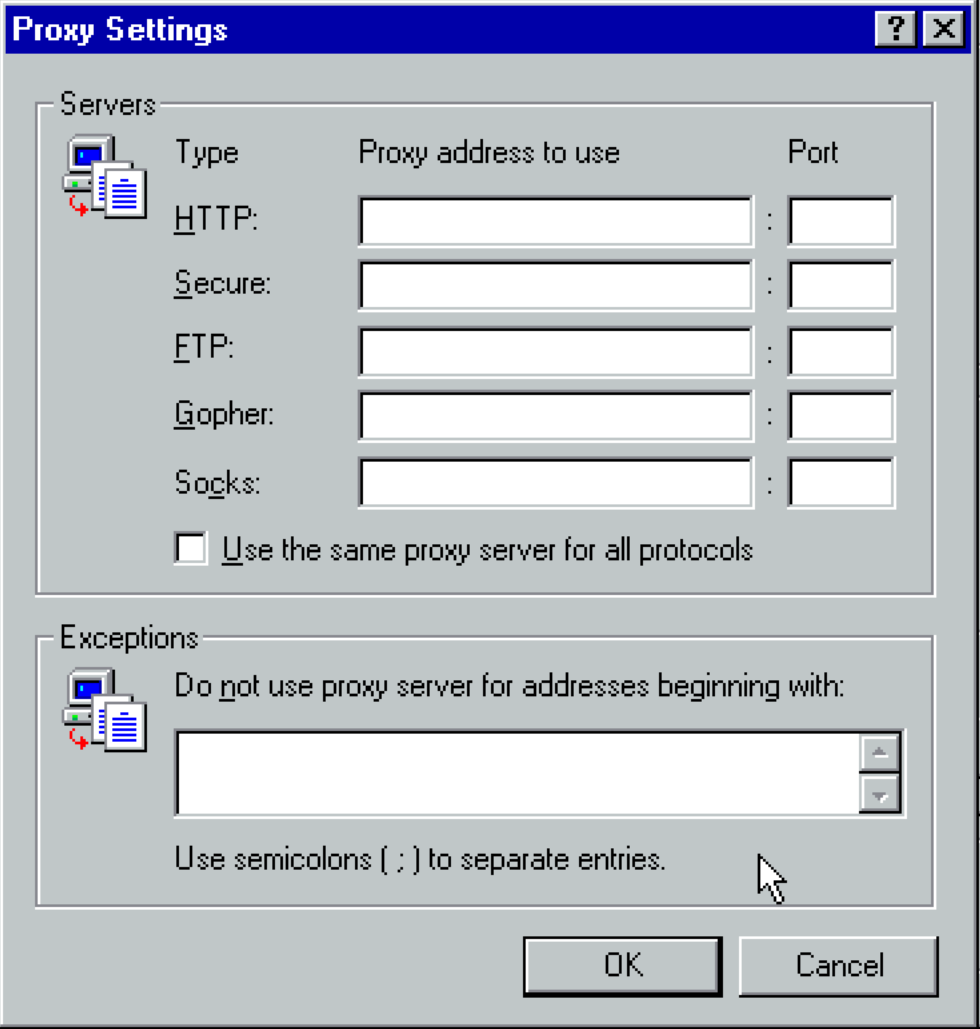
I was always a bit curious about this. At the time all major browsers
supported Gopher and occasionally would run into an elusive gopher:// link,
perfectly integrated with the rest of the web, but also feeling somewhat
alien.
In 2006 I learned about inetd on linux and it occured to me that I could
build a gopher server with PHP without needing to learn about sockets (which
seemed hard). So I made a little server and published it on this blog.
Most Linuxes don’t ship inetd by default anymore, but at the time it was a
great way to build simple TCP services without knowing anything about TCP.
Just reading and writing to STDIN and STDOUT was all you needed to do.
I never really kept that gopher site going, mainly because in order to host it, you need an IP address (no vhosts!) and a running server, and I didn’t really want to pay for that.
Then a few years later all major browsers dropped support for it (and Chrome never had support).
Fast forward to 2026, and I think gopher is in a bit of a resurgence. The protocol is very limited, and as a result it’s inherently a place without tracking, ads, comment boxes, corporate interests, AI, misinformation and short-form video. Now that the excitement and idealism of the internet in mid 00’s is dead and buried, Gopher (and Gemini) offers a little respite.
The biggest year for Gopher in this century was actually 2025, when the number of active gopher sites reached a whopping 432 according to Wikipedia, Most of these sites are just personal spaces, like the homepages of yore.
I also recently built a little homelab, so this seemed like the perfect time to finally set up a permament gopher server (or ‘hole’).
If this sounds interesting, go take a look:
- My Gopher site: gopher://hole.din.gy.
- The source on GH: https://github.com/evert/hole/ (feel free to fork and dig your own hole!)
To access gopher sites, the easiest is probably to use lynx, found in a
package manager near you, or you can use the shiny Lagrange client.
If you’re interested in the history of Gopher, Abort Retry Fail has a great article titled “The Internet Gopher from Minnesota”.